
Local AEO (Answer Engine Optimization) makes your pet business more likely to be recommended when people ask AI tools like ChatGPT, Claude, or Gemini “who is the best dog walker near me” or “find a pet sitter that cares for cats.” If you run a local pet service in 2026, optimizing your websites for answer engines like ChatGPT, Perplexity, and Google AI is essential if you want to be competitive. This blog post explains what AEO is, how it builds on SEO (Search Engine Optimization), and how to use it as a pet business owner.
What Is AEO (Answer Engine Optimization)?
AEO stands for Answer Engine Optimization, which is just a fancy way of saying: “Make your content easy for AI tools and search engines to understand and use as an answer.” Think of it as the next level on top of SEO.
SEO serves as a foundation for AEO, but AEO is (also called AI SEO) is designed for where more and more people are searching. Many of us are asking AI tools and answer engines for direct recommendations instead of scrolling through a list of links.
Instead of only trying to rank for keywords in blue links, you’re also trying to be the actual answer that shows up in:
- AI chat tools (like ChatGPT, Perplexity, Claude, Gemini)
- Voice assistants (“Hey Siri/Google/Alexa…”)
- Google’s AI Overviews and “People also ask” boxes
For a local pet business, that might mean being the answer to:
- “Who’s the most reliable pet sitter in [your city]?”
- “What should I ask a dog walker before I hire them?”
- “Best cat groomer for seniors near me.”
Do this: When you think AEO, think about the real questions clients ask you, not just “keywords.”
How Is AI Changing the Way Pet Owners Search?
If you feel like Google doesn’t just list “ten blue links” for a search anymore, you’re not imagining it.
Here’s how online search is evolving:
- More “conversational” searches
People type or speak full questions like “how often should I walk a 6‑month‑old lab puppy” instead of just “lab puppy walk schedule.” - AI tools giving direct answers
They summarize answers from multiple sites instead of sending users to one website at a time. - Local intent is baked in
When someone searches “dog walker” from their phone, platforms assume they want results near them, even if they don’t type the words “near me.” - Trust signals matter more
Consistent information (name, address, phone), reviews, and clear service pages help engines decide which local businesses are safe to show as answers.
Good news: local pet businesses, and other lcoal businesses, that optimize early for these changes can grab visibility while everyone else is still stuck in 2018.
How Local AEO Builds on Traditional SEO
You don’t have to throw out SEO; AEO builds on what you already know. Good SEO gets you in the door, but it doesn’t guarantee the AI picks you to quote. What actually gets you picked is being clearly structured, getting mentioned a lot in places beyond your own site, and staying current, not just your search ranking position.
Here’s a bit of a rundown on SEO vs AEO:
Keywords
SEO Focus: Short phrases like “dog walker [city]”
AEO Focus: Full questions like “how do I choose a good pet sitter in [city]”
Content
SEO Focus: Blog posts, service pages, location pages
AEO Focus: Clear, direct answers, FAQs, step-by-step explanations
Technical
SEO Focus: Site speed, mobile friendly, meta tags
AEO Focus: Structured data, schema, clear headings and answer blocks
Local Signals
SEO Focus: Google Business Profile, citations, reviews
AEO Focus: Bring the most trustworthy, clearly relevant answer for local queries
If SEO is about being visible, AEO is about being chosen as the answer.
Do this: Keep using existing SEO best practices (titles, meta descriptions, keywords), but start writing content that answers specific client questions clearly in the first paragraph.
Why is Local AEO Important for Pet Businesses?
Pet businesses are hyper‑local and deeply trust‑based, which makes local AEO especially powerful.
Here’s why it matters for you:
- Pet owners want quick, confident answers
A busy dog owner doesn’t want to go through 10 sites; she wants to know “who will keep my dog safe and happy while I’m at work.” - You compete with big players and apps
Rover, Wag, national chains, and large veterinary groups all invest in SEO and AEO. Strong local AEO helps you show up beside (or above) them when people look for local help. - Trust is everything super important when it comes to pet care
When AI tools and search engines see consistent information, strong reviews, and clear answers on your site, they’re more likely to cite you as a trustworthy local option. - Local search often leads to fast bookings
Local searchers are usually ready to act. People don’t casually search “emergency vet near me” or “cat boarding near [city]” for fun. Showing up as the answer here is money.
Do this: Make a quick list of 10 real questions clients have asked you in the last month. That list is pure AEO gold, if you can answer them on your website.
How Do I Optimize My Pet Business Website for Local AEO?
You don’t need a giant marketing department to get started. A lot of AEO work is about how you explain things, answer questions, and structure content you’re probably already planning to write.
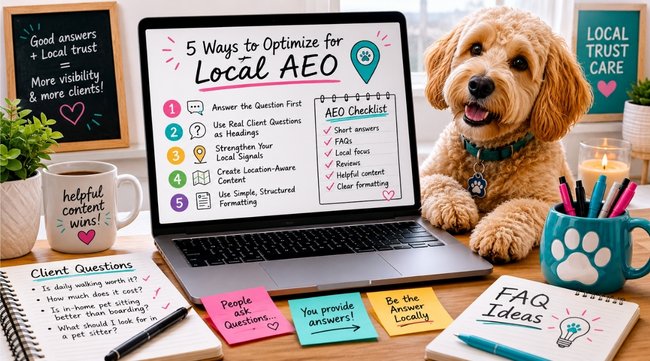
1. Answer the Question First
When you write a blog post or service page, start with a direct, conversational answer in the first 1–3 sentences.
Example for a dog walking FAQ:
“Is daily dog walking worth it?”
Short answer: Yes. Most dogs benefit from at least one structured walk a day to burn energy, prevent boredom, and support good behavior, especially if you work outside the home.
Then you can expand with:
- Why it matters for health and behavior
- How often most dogs need walks
- When it makes sense to hire a pro vs DIY
Do this: Edit your existing service pages to add a one‑sentence “short answer” near the top for big questions like “Is pet sitting safer than boarding?” or “How much does dog walking cost in [city]?”
2. Use Real Client Questions as Headings
Those “People also ask” questions you see in Google? They’re a giant hint about how people search.
On your site, use headings like:
- “How much does dog walking cost in [your city]?”
- “Is in‑home pet sitting better than boarding for anxious dogs?”
- “What vaccinations does my dog need for daycare in [your state]?”
Then answer each question in 2–4 clear sentences right below the heading.
Do this: Add an FAQ section to your most important pages (Home, main services, and location‑specific pages) using actual questions people ask you.
3. Strengthen Your Local Signals
Local AEO isn’t just what’s on your website! It’s also everywhere your business shows up online.
Make sure you have:
- A complete, up‑to‑date Google Business Profile (hours, services, photos, service area).
- Consistent name, address, phone number on your website and major listings.
- A steady flow of recent reviews that mention your services and city or neighborhood when possible.
These signals help AI and search tools understand more about your business: this business, in this location, is a reliable answer for these services, and has positive reviews.
Do this: Update your Google Business Profile description to clearly state who you serve, where you work, and what makes you different (e.g., “fear‑free cat‑only sitter in [city]”).
4. Create Location‑Aware Content
Pet parents search with local context, even when they don’t explicitly type the city.
Great AEO‑friendly topics for pet pros include:
- “Best dog‑walking routes in [city] for reactive dogs”
- “How hot is too hot for dog walks in [city] summers?”
- “Boarding vs pet sitting in [city]: what local pet parents should know”
These posts are perfect for:
- Ranking in local search
- Being used as sources by AI tools when answering city‑specific questions
Do this: Pick one “evergreen” local topic and one seasonal one (e.g., summer heat safety, winter paw care in your region) and write short answer‑first blog posts for each.
5. Use Simple, Structured Formatting
Answer engines love content that’s easy to scan and understand.
On your pages and posts:
- Use clear headings that sound like questions.
- Break up text with short paragraphs and bullet points.
- Include quick definitions and “Short answer:” lines.
- Add an FAQ section at the bottom of key pages.
Tools like Rank Math on WordPress make it easier to add structured data (like FAQ schema), which is a more advanced AEO move you can grow into later.
Do this: On your next blog post, include at least 3–5 FAQ‑style questions and answers that you could later mark up with FAQ schema.
Local AEO Keywords and Phrases to Target
You don’t need to stuff keywords, but you do want to sprinkle in phrases that reflect how people actually search.
Examples for pet business owners:
- “local dog walker in [city]”
- “dog daycare in [neighborhood]”
- “cat‑only boarding in [city]”
- “how to choose a safe pet sitter in [city]”
- “best dog trainer for reactive dogs in [city]”
Mix in a blend of:
- Service + city (“dog boarding in [city]”)
- Service + problem (“dog trainer for leash pulling”)
- Question‑style phrases (“how to find a reliable pet sitter”)
Do this: On your homepage and main service pages, naturally use at least 2–3 local phrases that match how your ideal clients talk, not how marketers talk.
Frequently Asked Questions About Local AEO for Pet Businesses
Is AEO replacing SEO, or do I need to do both?
Both. AEO builds directly on the SEO fundamentals you already have. This includes things like site speed, mobile-friendliness, well-structured content, and keywords. SEO to chase AEO would undercut the foundation answer engines pull from in the first place.
How long does it take to see results from local AEO?
It’s possible to start seeing citations in AI answers within 4–8 weeks of consistent changes, though full visibility gains often take 2–3 months. AI tools need to recrawl and re-index your site, and trust signals like reviews build over time, not overnight.
Do I need to know how to code to do schema markup?
No. Plugins like Rank Math handle most basic schema (like FAQ markup) for WordPress websites without touching code. Website builders like Wix now have built-in structured data fields for local businesses.
Will this work for a really small or one-person pet business?
Yes, it can work quite well. Local AEO rewards specific, clearly-answered local content over generic corporate pages, which is exactly the kind of detail a solo dog walker or single-location boarding business can write with more authenticity than a national chain.
How Do I Get Started with Local AEO If I Only Have an Hour This Week?
Add a short, direct answer to one question your clients actually ask you on your most important service page. That one change will help both your SEO and your AEO at once, and it’s the fastest win on this whole list.
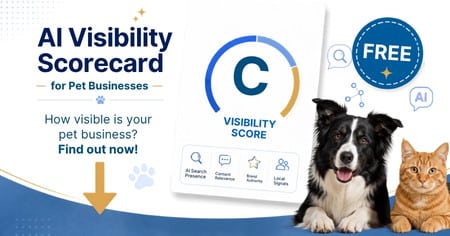
Is Your Website Ready for AI Search?
Find out with this quick quiz! It’s Free!
See how visible your pet service business is to AI engines like ChatGPT, Perplexity, and Google AI.

Therese Kopiwoda has been designing websites since 2001, when she built the site for her own pet sitting business. She now specializes in custom web design and AEO (Answer Engine Optimization) alongside SEO, helping pet businesses and local service companies get found in Google and cited by AI tools like ChatGPT. Learn more about Therese.