
Picture this. A pet owner in your town is heading out of town next month. They’re nervous about leaving their dog. So they open up ChatGPT and type: “Who’s the best pet sitter in [your city]?”
Rover comes up. Maybe Wag. Maybe a couple of generic results from Yelp.
Your name? Not there.
This isn’t because you’re not as good as a Rover sitter. You’re probably better. You’re insured, certified, experienced, and volunteer with a local rescue. But AI doesn’t know that yet. And until you give it a reason to trust you, it’s going to keep pointing pet owners toward the apps.
The good news: that can change. And most of your competitors haven’t figured this out yet.
Here’s what’s happening, and what you can do about it.
Why Rover and Wag have a head start in AI search
AI tools like ChatGPT, Google’s AI Overviews, Perplexity, and others don’t browse the internet in real time the way Google does. Instead, they’ve been trained on massive amounts of text from across the internet. This includes articles, directories, review sites, news stories, blog posts. When someone asks an AI tool for a recommendation, it pulls from all that material to figure out which businesses are trustworthy and well-known.
Rover has been mentioned in thousands of those sources. Pet industry publications, local news stories, “best pet apps” roundups, Reddit threads, personal blogs. Every single one of those mentions tells AI: this is a credible, established option.
Your small business? Probably mentioned in far fewer places. Which means AI has less evidence that you exist and are trustworthy, even if you’ve been serving your neighborhood for a decade.
That’s the gap. The question is how to close it.
What AI actually looks for when recommending a local pet sitter
This is the part most pet sitters (and honestly, most web designers) don’t fully understand yet. AI engines don’t just look at your website. They look at as much information they can find about your business across the web. And they’re weighing four things in particular.
A clear, consistent online presence
Your website needs to make it immediately obvious what you do, exactly what you do, where you do it, and who you serve. If a potential client has to dig to figure out what services you offer or which neighborhoods you cover, AI has the same problem. The thing is though, AI will quickly move on to a competitor whose site is clearer. This means specific service pages, a clear service area, and a website that is written for real clients, not just Google bots.
Third-party mentions across the Internet
AI looks at where else your business appears online. Review sites, local directories, professional association listings, community blogs, local “best of” lists. If your business is only mentioned on your own website, AI has no external confirmation that you’re an established, trusted option. The more credible places you appear, the more evidence AI has to include your website in answers.
Detailed, specific reviews
This one surprises most people. Ten five-star reviews that say “Great pet sitter!” tell AI almost nothing. What AI needs are reviews that mention your specific services, your actual location, and real results. “Sarah walked our two Labs in the Broad Ripple neighborhood every weekday for six months and they were always calm and happy when we got home” is worth more than a dozen generic five-star ratings.
Structured data on your website
This is the technical piece that most small business websites are missing. Schema markup (also called structured data) is a layer of code on your website that tells AI and search engines exactly what your business is, what services you offer, where you’re located, and how to contact you. Without it, AI is doing its best to interpret your website. With it, you’re handing AI a clear answer. Think of it as labeling every drawer and cabinet in your kitchen with what’s in there. Somebody walking in could easily find a glass if they wanted a drink of water.
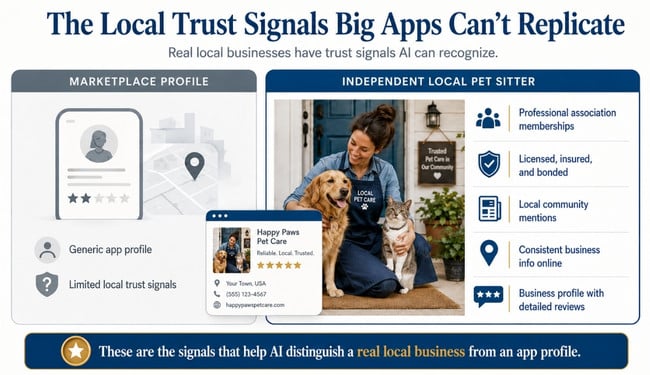
The Local Trust Signals Big Apps Can’t Replicate
Here’s the thing Rover can’t replicate, no matter how big they get: you’re a real local business with a real name, a real service area, and a real community presence. And that’s exactly what AI increasingly favors.
Rover is a marketplace. You’re a real local business with a real name, a real service area, and a real community presence. The majority of individual sitter profiles inside a marketplace don’t have their own websites, their own Google Business profiles, their own professional association credentials, or their own local press mentions. As a small business you may very well have all of that.
As an independent pet sitting professional, you have access to trust signals that app-based gig workers often don’t have:
- Membership in Pet Sitters International (PSI) or NAPPS — these are credentialed professional associations that AI engines recognize as authoritative
- A business license, insurance, and bonding — signals of legitimacy that anonymous app sitters don’t always carry
- Local community mentions — neighborhood Facebook groups, local business directories, hometown news features
- A consistent business identity with your name, address, and phone number appearing the same way across the web
- A Google Business Profile with positive, detailed reviews
These are the things AI uses to distinguish a real, established local business from an app profile. And they’re things you can actually build.
Five things you can do this month to get ahead of the apps
You don’t need to overhaul your entire business. Start here.
Audit what AI says about you right now.
Open ChatGPT, Google Gemini, and Perplexity. Search for “best pet sitter in [your city]” and “dog walker near [your neighborhood].” See what comes up. If you’re not there, that’s your baseline. Doing this audit now means you’ll be able to see your progress as you make changes.
Get listed in professional directories AI trusts.
PSI, NAPPS, and your regional pet sitter association are the kinds of credentialed directories that AI engines recognize as authoritative. These listings do double duty. They build your human reputation and your AI visibility at the same time.
Ask your best clients for detailed, specific reviews.
Don’t just ask for a review. Instead, give them a nudge in the right direction. Something like: “If you have a minute, it would help so much if you could mention the services you use and the neighborhood you’re in.” A handful of detailed, specific Google reviews will do more for your AI visibility than dozens of generic stars.
Clean up your website’s front page.
Your homepage should make a four things crystal clear within the first few seconds: what you do, exactly where you do it, who your service is for, and how to reach you. If someone has to scroll or click around to find your service area or your phone number, your website is failing, with both clients and AI tools.
Add structured data to your website
Remember the labels on the kitchen cabinets and drawers? That’s what this is. This is the technical step most pet sitting websites (and most websites, regardless of industry) skip entirely, and it’s one of the most direct ways to close the gap with Rover.
Structured data (also called schema markup) is a layer of code on your website that tells AI exactly what it needs to know about your business, in a format it can read without guessing. There are four types that matter most for a local pet sitting business:
LocalBusiness schema is the foundation, it tells AI your business name, address, phone number, hours, and service area in an unambiguous, machine-readable format. This is how AI knows where you are when someone searches for a pet sitter in your city. Without it, AI is making educated guesses.
Service schema specifies exactly what you offer — dog walking, overnight stays, drop-in visits — so AI doesn’t have to interpret your homepage copy to figure out if you’re the right fit for a searcher’s needs.
Review schema surfaces your ratings and review count directly to AI engines, reinforcing the trust signals that get you recommended in the first place.
FAQ schema formats your answers to common client questions in a way AI can pull and cite directly. When someone asks ChatGPT “what should I look for in a pet sitter?,” a well-structured FAQ on your site is exactly the kind of source it draws from.
Most pet sitting websites have none of this. Which means adding it puts you ahead of the majority of your local competition immediately.

Now is the time to get started
Rover has years of head start in traditional search, along with a much bigger marketing budget than most pet sitting businesses have. But AI-powered search is still new enough that the playing field is more level than it’s going to be in the next year or two. Most independent pet sitters haven’t started thinking about any of this yet.
That means right now, before this becomes standard practice in the pet industry, is genuinely the best time to move. The businesses that build their AI visibility now are going to have the advantage when AI-powered search becomes the default way people find local services.
You don’t need to figure all of this out alone. If you’d like a clear picture of where you stand right now (and exactly what’s worth fixing first) an AI Visibility Report is a good place to start. It audits how you show up across the major AI platforms and gives you a prioritized action list specific to your business.
Because the pet owner who’s typing into ChatGPT right now deserves to find you.
Frequently asked questions
What is AEO and how is it different from SEO?
SEO (Search Engine Optimization) is about getting your website to rank well in Google search results. AEO (Answer Engine Optimization) is about getting your business cited by AI tools like ChatGPT, Google’s AI Overviews, and Perplexity. The two overlap. A well-optimized website helps with both, but AEO requires additional steps like structured data and consistent third-party mentions that traditional SEO doesn’t prioritize.
How long does it take to show up in AI search results?
There’s no single answer because it depends on how competitive your local market is, how much work you put in, and how frequently AI tools update their training data. Here are a few things you can do for quicker results
– Auditing and correcting your NAP (name, address, phone number) so it appears identically across every directory, listing, and social profile. Inconsistent NAP is one of the most common reasons AI engines discount a local business.
– Adding structured data to your website so AI can read your business details without guessing.
– Getting listed in a credentialed professional directory like PSI or NAPPS.
Do I need a web designer to add structured data to my site?
Not necessarily, but it depends on your website platform and comfort level with technical settings. Some website builders have basic schema tools built in. Others require a plugin or manual code. The challenge is that structured data done incorrectly can actually confuse AI engines rather than help them. So if you’re not confident in the technical side, it’s worth getting it done right the first time by someone who specializes in it.
Can I still show up in AI search if I’m also listed on Rover?
Yes. Being listed on Rover doesn’t hurt your independent AI visibility, and building your own AI presence doesn’t require leaving Rover. The goal is to make sure that when a pet owner searches for a sitter in your area, your independent business shows up alongside (or better yet, instead of!) the app results. The two can coexist, but your long-term business is better protected when clients can find and book you directly.
What if I don’t have a website at all?
A website is the foundation everything else builds on. Think of it as your world headquarters. Without one, you have no place to add structured data, no home base for AI to point people toward, and no way to control how your business appears online. The steps in this post will have limited impact without a website behind them. If you don’t have one yet, that’s the starting point.
Is Your Website Ready for AI Search?
Find out with this 2-minute quiz. It’s FREE!
See how visible your pet service business is to AI engines like ChatGPT, Perplexity, and Google AI.

Therese Kopiwoda has been designing websites since 2001, when she built the site for her own pet sitting business. She now specializes in custom web design and AEO (Answer Engine Optimization) alongside SEO, helping pet businesses and local service companies get found in Google and cited by AI tools like ChatGPT. Learn more about Therese.