
I get this question a lot, usually from pet sitters, dog walkers, groomers, and trainers who are either just starting out or need a new website because the one they have isn’t bringing in enough clients. The answer isn’t the same for everybody. But I’ve been building websites since 2001, so I’ve seen this enough times to have some pretty strong opinions about it.
Here’s a story that sums it up pretty well.
The owner of a pet sitting business came to me after building her own site on a DIY platform. She’d put real effort into it, but she wasn’t getting enough clients, and wasn’t really attracting her ideal clients. So we rebuilt it with the look and feel she was going for; an easy going, hippy vibe that matched who she was. But unlike the DIY website this one was built with the SEO structure and content that actually helps get it to show up so people can find it. Three months later, the new site had already paid for itself, and she was attracting exactly the kind of clients she wanted…her ideal clients.
As a side note, that was a few years ago, before AI search became so prevalent. We recently made some changes to the website. It’s still showing up high in Google searches but now the business is getting clients from ChatGPT and other AI tools. But…that’s whole nother blog post!
That’s really the difference between DIY and hiring someone. It’s not that DIY sites look bad. Plenty of them look great. Heck, I’ve even seen some that I use as inspiration for my designs! It’s that looking great and getting found are two different things, and most builders only help you solve one of them.
My experience with DIY and professional websites
I built my first website back in 2001 for my own pet sitting business, LucyGirl Pet Sitting. Other pet sitters saw it, liked it, and started asking me to build theirs too. That’s how I got into this, and I’ve been doing it for pet care businesses ever since. Over the years I’ve spent plenty of time and money learning SEO, web design, marketing, Answer Engine Optimization (AEO), and more.
These days I work mostly in WordPress, using Divi for design along with tools like RankMath for SEO and AEO, WP Rocket for speed, and Fluent Forms for lead capture. So when I talk about what’s “hard” about DIY builders, it’s not theoretical. It’s stuff I fix for clients on a regular basis. And every person I work with benefits from all those years of experience.
Where DIY websites commonly fall short
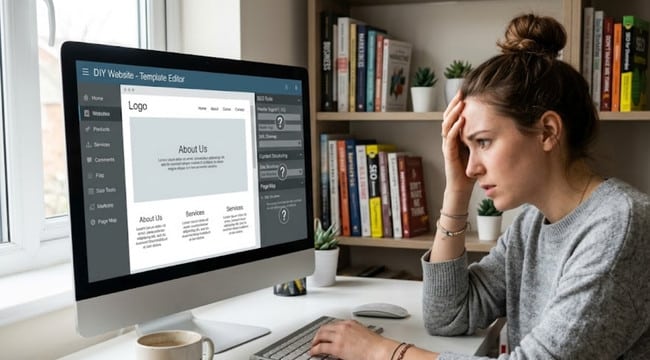
When business owners try to build their own site, hear are some of the things they either have trouble with or don’t work on because they don’t even know about:
Technical SEO
This is the behind the scenes work. Stuff like page speed, how your site is structured, header tags, alt text, and more. All of this factors into whether search engines and AI tools like ChatGPT, Perplexity, Google AI Overviews and others can actually understand what your business does. Most DIY builders give you a nice-looking template, but they don’t teach you how to make Google (and AI tools) understand your business.
Writing and structuring the content
There’s a big difference between writing words that describe your business and writing and structuring content that get you found by the right client and convince them to book. A lot of DIY sites read like a brochure. They tell you what services are offered, but they don’t answer the questions your ideal client is actually typing into Google or asking AI.
Knowing what pages you actually need
This one surprises people. It’s not just “homepage, about, services, contact.” Depending on your business, you might need dedicated pages for each service, location pages if you serve multiple areas, and specific images that build trust rather than just filling space. Getting this structure wrong means you’re invisible for searches you should be winning.
When DIY makes sense
I’ll be the first to say hiring a designer isn’t right for everyone. If you’re working with a very limited budget, or you’re building a site just for fun, like a place to show off your art, writing, or photography rather than to generate business, a DIY builder is a perfectly reasonable choice.
Where I don’t recommend it is when someone is serious about growing a business, especially if they don’t already understand SEO (or AEO, more on that in a minute). In that case, the gap between “a website exists” and “a website brings in clients” is exactly where DIY builders tend to fall short. Plus, most small business owners are doing so many jobs as it is, that trying to figure all this stuff out can be too overwhelming, and not a good use of their time.
DIY website builder vs. web designer costs
To be fair to the DIY option, the entry price is hard to beat. Squarespace starts around $16 a month, Wix around $17. That’s a real bargain if all you need is a simple online presence.
Hiring someone is a bigger upfront investment, but it’s a one-time cost rather than a forever bill. Most of my custom website projects run somewhere between $2,800 and $6,000, depending on the scope. It’s not a trivial amount, but when I hear from clients that their new site paid for itself in a few months, it starts to look less like an expense and more like the best marketing money they spent all year.
Are you ready to hire a professional? A quick checklist
If most of these sound like you, it’s probably time to bring someone in:
- You’re relying on your website to actually bring in paying clients, not just exist online
- You’ve tried DIY and you’re not getting the leads or the kind of clients you want
- Terms like technical SEO, site structure, or schema markup make your eyes glaze over
- You don’t have hours to spend learning a builder platform on top of running your business
- You want a site that reflects your brand’s personality and ranks well, not one or the other
If none of that applies yet, and you’re just testing the waters or building something for fun, a DIY builder is a fine place to start.
How AI search changes the DIY website decision
It’s not just Google you need to be found by anymore. Tools like ChatGPT and Perplexity are now recommending businesses directly to people who ask “who’s a good dog walker near me” or “what pet sitter should I hire.” That’s a new skill set that works along with traditional SEO, and it’s something most DIY builders aren’t built to handle. This is one more reason the site structure for your pretty design matters more than ever.

FAQ about hiring a web designer vs. a DIY website
Is a DIY website builder good enough for a small business?
It can be, especially when you’re just starting out or working with a tight budget. Where it tends to fall short is technical SEO and site structure, the parts that help you actually get found by the clients you want, not just look good to the people who already know you.
How much does it cost to hire a web designer vs. using Squarespace or Wix?
DIY builders like Squarespace and Wix start around $16 to $17 a month. Hiring a designer is a bigger upfront investment, often a one-time fee somewhere between $2,800 and $6,000 depending on scope, but there’s no ongoing subscription tied to it.
Can I switch from a DIY website to a custom one later?
Yes, and a lot of my clients do exactly that. It’s common to start with a DIY builder to get something online fast, then move to a custom, properly optimized site after the business is established enough that the website’s performance actually matters to revenue.
Do DIY website builders hurt my SEO?
Not automatically, but most people building on them don’t know how to set up technical SEO correctly, or what page structure and content their business actually needs. The platform isn’t usually the problem. The lack of knowledge behind it is.
Will a DIY website show up in AI tools like ChatGPT?
It can, but again, the person building it needs to know how to build it so the tools can find and recommend it. AI tools rely heavily on how clearly a site’s structure and content communicate what your business does, which is exactly the kind of technical setup you won’t get with DIY builders.
Here’s what I tell my friends
A DIY builder can get you online quickly and cheaply. But if you’re serious about your business, the real cost isn’t the monthly subscription. It’s the leads and ideal clients you never see because the structure of the website doesn’t have all the technical work for it to be found. Twenty five years of doing this has taught me that a website is either working for your business or it’s just sitting there. There isn’t much middle ground.
If you want to figure out where your own site stands, grab my free website design checklist. It walks through exactly what a website needs to actually bring in business, not just look nice.

Therese Kopiwoda has been designing websites since 2001, when she built the site for her own pet sitting business. She now specializes in custom web design and AEO (Answer Engine Optimization) alongside SEO, helping pet businesses and local service companies get found in Google and cited by AI tools like ChatGPT. Learn more about Therese.